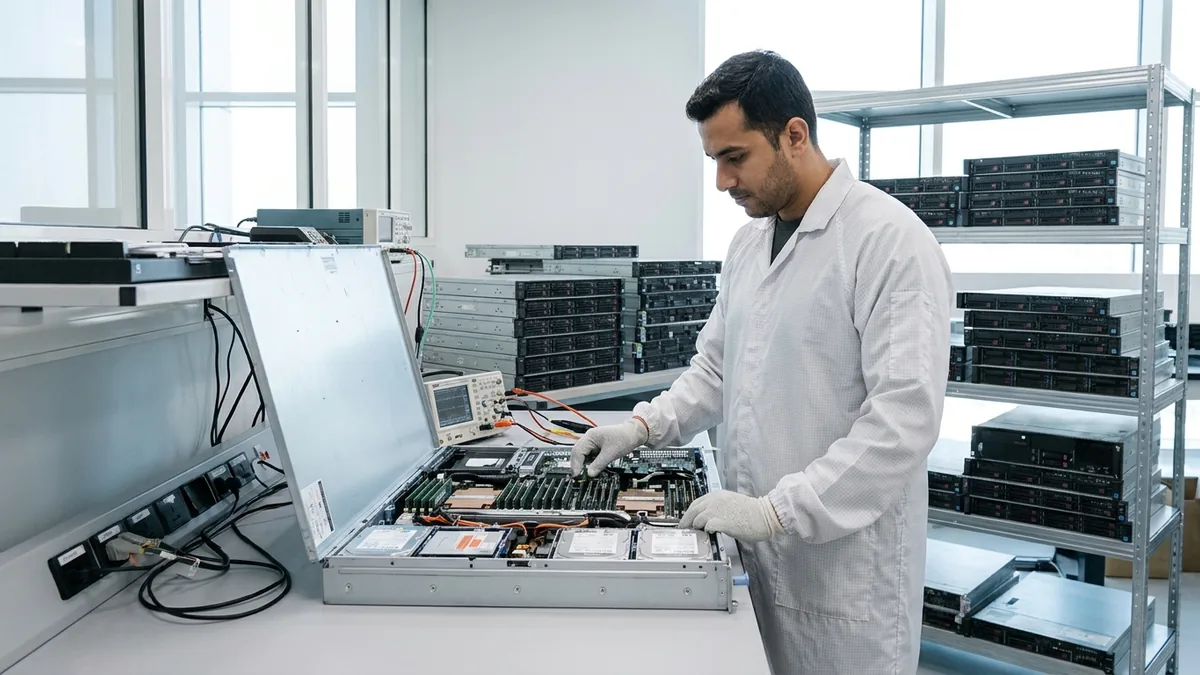
A new Dell PowerEdge or HPE ProLiant looks like the safe choice. A refurbished one looks like the cheap choice. Neither label tells you what the server will actually cost your business over the next three to five years in the UAE. This guide breaks down the total cost of ownership (TCO) of refurbished versus new servers, line by line, with a worked example, so you can make the decision on numbers rather than instinct.
What total cost of ownership really includes
The purchase price is usually less than half of what a server costs over its life. A fair refurbished vs new server TCO comparison needs all of these:
| Cost line | New server | Refurbished server |
|---|---|---|
| Purchase price | Highest | Typically 40 to 70 percent lower for the same configuration |
| Lead time | Often 2 to 8 weeks for custom builds | Often in stock locally, days not weeks |
| Warranty and support | 3 to 5 years OEM, paid extensions | Supplier warranty, often 1 to 3 years, optional third-party maintenance |
| Power consumption | Better performance per watt | Older generations draw more per unit of work |
| Cooling | Lower heat per workload | Higher heat per workload |
| Software licences | Per-core licensing can cost more if you buy more cores than you need | Same rules; fewer, older cores can reduce or increase cost depending on the licence |
| Downtime risk | Low early failure rate after burn-in | Depends heavily on the supplier's testing |
| Resale value | Higher residual value after 3 years | Lower, but you paid less to begin with |
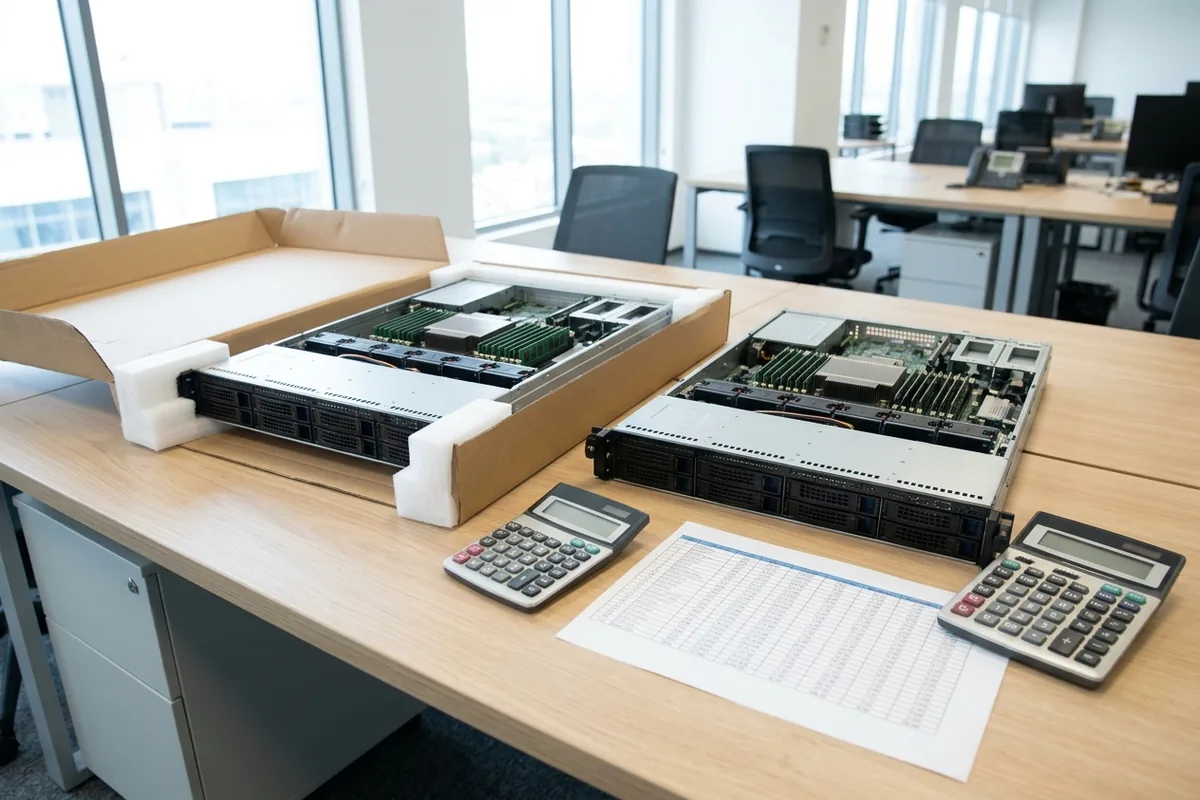
A worked example: virtualisation host for a Dubai SME
Take a typical requirement: a two-socket virtualisation host for about 25 virtual machines, with 512 GB RAM and 8 TB usable SSD storage. Compare a current-generation new server with a refurbished previous-generation one. The figures below are illustrative ranges for the UAE market; your quote will vary with configuration and timing.
| Item (3 years) | New (current generation, e.g. Dell R760) | Refurbished (previous generation, e.g. Dell R750 or R740) |
|---|---|---|
| Hardware | AED 55,000 to 75,000 | AED 18,000 to 30,000 |
| Support or extended warranty | Included or AED 4,000 to 8,000 | AED 3,000 to 6,000 |
| Power (about 450 W vs 550 W average, 24/7) | about AED 4,300 | about AED 5,200 |
| Cooling overhead (roughly 50 percent of IT power in a small server room) | about AED 2,200 | about AED 2,600 |
| Indicative 3-year total | AED 61,500 to 89,500 | AED 29,000 to 44,000 |
Power is estimated at a commercial tariff of roughly AED 0.36 per kWh; check your own DEWA or ADDC rate. Even after adding higher power and cooling costs, the refurbished option is typically around half the three-year cost in this scenario. The gap narrows only when the workload needs the extra performance of the new platform, for example when one new server replaces two older ones.
When a new server wins the TCO comparison
- Consolidation: if one new server with high-core-count CPUs replaces two or three older ones, you save on power, rack space and per-socket licences.
- Per-core licensing: software like Windows Server Datacenter, SQL Server or some virtualisation platforms is priced per core. If an older platform needs more cores to deliver the same performance, licences can wipe out hardware savings.
- Long life cycle: if you plan to run the server for seven years, starting with the newest platform delays the next refresh.
- Latest features: PCIe Gen5, DDR5, CXL, or GPU support for AI workloads require current platforms.
- Compliance requirements: some tenders and regulated projects require new hardware with OEM warranty.
When a refurbished server wins
- Budget-limited projects: startups, branch offices, labs, development and test environments.
- Fast deployment: when you need hardware this week, not next month.
- Known, stable workloads: file servers, backup targets, domain controllers, small ERP systems that do not need the newest CPU.
- Matching an existing estate: adding identical nodes to a cluster built on a previous generation keeps management simple.
- Spare capacity: keeping a cold standby server for disaster recovery at a fraction of new cost.
How to reduce the risk of buying refurbished
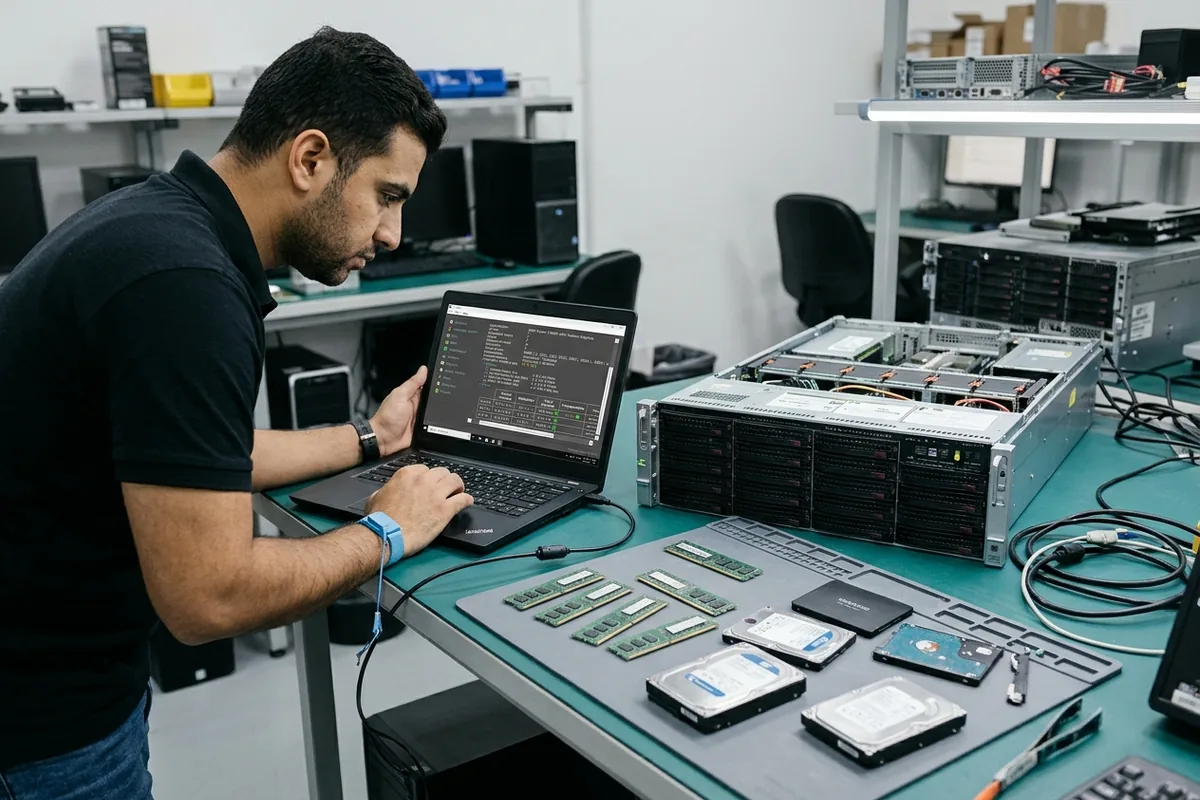
The TCO advantage only holds if the server does not fail early. Most of the risk sits with the supplier, not the hardware generation. Before you buy, check:
- Testing process: ask what burn-in and diagnostics are run. Memory, drives and power supplies should be tested individually.
- Warranty terms: length, response time, and whether replacement parts are stocked locally. See our guide to refurbished server warranty.
- Drive and memory condition: new or tested drives, and memory that matches the platform's supported list. Our server RAM compatibility guide covers what to check.
- Firmware: BIOS, iDRAC or iLO and RAID controller firmware should be updated before delivery. If you are choosing between Dell and HPE management, read iDRAC vs iLO.
- Genuine parts: avoid grey-market or counterfeit components. Our article on spotting fake or grey-market servers explains the warning signs.
A simple decision framework
| Question | If yes |
|---|---|
| Does the workload need PCIe Gen5, DDR5 or modern GPUs? | New |
| Will one new server replace two or more old ones? | Calculate both; new often wins |
| Is software licensed per core and expensive? | Calculate licences carefully before choosing |
| Is the budget fixed and the workload stable? | Refurbished |
| Do you need the hardware within days? | Refurbished |
| Is this a lab, test, backup or DR server? | Refurbished |
Many businesses end up with a mix: new servers for the core production workload, refurbished servers for everything around it. For model-specific comparisons, see Dell R750 vs R740 and HPE DL380 Gen10 Plus vs Gen10.
Want a side-by-side quote? Tell ITCT your workload and we will price both a new and a refurbished server configuration with a three-year cost estimate, so you can compare real numbers. Replacing older hardware? We also buy used IT equipment in the UAE.
Frequently asked questions
Is a refurbished server cheaper than a new server over three years?
In most SME scenarios, yes. A refurbished previous-generation server often costs about half as much over three years, even after higher power and cooling costs. New servers win when they consolidate several older machines or reduce expensive per-core licences.
How long does a refurbished server last?
A properly tested enterprise server from Dell, HPE or Lenovo can run reliably for another three to five years. Fans, drives and power supplies are the most common replacement parts, and they are inexpensive and easy to swap.
Do refurbished servers use more electricity?
Older generations usually deliver less performance per watt, so they use more power for the same amount of work. For a single server the difference is often a few hundred dirhams a year; it matters more in large deployments.
Are refurbished servers reliable enough for production?
Yes, if they come from a supplier that tests every component and offers a real warranty. Many UAE businesses run production ERP, file and virtualisation workloads on refurbished hardware, often with a spare unit for redundancy.
What warranty should I expect on a refurbished server in the UAE?
Typically one to three years from the supplier, with optional extended or third-party maintenance. Check the response time and whether spare parts are held locally in the UAE.
Conclusion
New versus refurbished is not a question of quality; it is a question of fit. Put power, cooling, licences, support and lead time into the calculation, not just the price tag. For stable workloads with fixed budgets, refurbished servers usually win on total cost of ownership. For consolidation, licence-heavy or cutting-edge workloads, new hardware can pay for itself. Run the numbers for your own case before you commit.