
When a power supply fails in a production server at 2 a.m., the difference between a five-minute swap and a two-week outage is whether the spare is already on the shelf. Many data centers in Dubai and the wider Gulf run hardware that is several years old, past its original support contract, and depend on parts that are no longer easy to order. A simple spare parts strategy protects uptime without tying up a large budget. This guide explains which data center spare parts to keep on site, how many, and how to source them reliably.
Which spare parts fail most often
| Part | Why it fails | Keep on site? |
|---|---|---|
| Hard drives and SSDs | Mechanical wear, write endurance | Yes, matched to each array and server model |
| Power supplies | Heat, capacitor ageing, power events | Yes, one per model family |
| Fans | Bearings wear, dust | Yes, cheap and quick to swap |
| Memory DIMMs | Correctable errors that grow over time | A few per server generation |
| Optical transceivers and cables | Handling damage, dirty connectors | Yes, for each speed and type you run |
| RAID controllers and batteries | Cache battery ageing | For critical storage systems |
| Motherboards and CPUs | Rare failures | Usually a support contract or quick supplier |

How many spares do you need?
A practical starting rule for most mid-size environments:
- Drives: about 3 to 5 percent of the installed count of each model, with at least one per model.
- PSUs and fans: at least one per server or storage model; more for large fleets of the same model.
- Optics: 2 to 5 percent of installed ports per transceiver type.
- DIMMs: two or more of each size and speed in use.
Adjust using your own failure history: if the ticket system shows drive replacements every month, keep more drives; if PSUs never fail, keep the minimum.
Match part numbers exactly
- Use the vendor spare part number, not just the description. Two "960GB SSDs" for the same server can have different firmware or carriers.
- Check firmware compatibility, especially for drives in storage arrays and RAID sets.
- Keep the correct drive caddies and rails with the spare.
- Record serial numbers and test date for every spare so you know it works before you need it.
Sourcing spares for older hardware
For servers and storage that are end of life, new parts may be gone from distribution. Tested refurbished parts from a specialist supplier are often the only option and usually cost much less than new. Read our guide to sourcing EOL IT parts in Dubai. If many parts are becoming hard to find, it may be cheaper to replace the platform; compare options in refurbished servers in Dubai.
Storage and handling
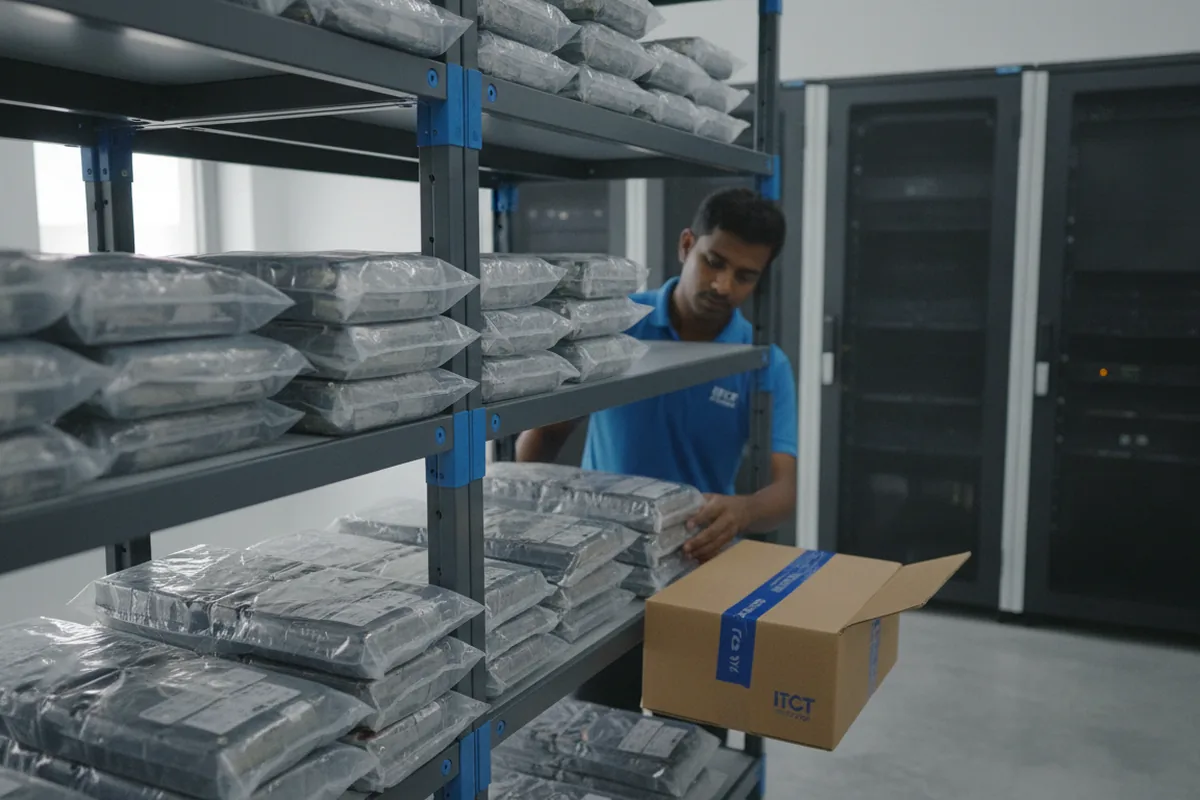
- Keep spares in anti-static packaging in a dry, cool room, not in the hot aisle.
- Label shelves by model and part number.
- Rotate and test stock once or twice a year.
- Replace a spare immediately after it is used; an empty shelf is the most common failure of a spares plan.
Spares or support contract?
Vendor support contracts with four-hour response make sense for critical systems still in support. For older hardware outside support, or for non-critical systems, an on-site spares kit plus a reliable parts supplier is usually more cost-effective. Many teams combine both. For storage systems, see refurbished storage arrays.
ITCT Shop supplies tested spare parts for Dell, HPE, Cisco and other enterprise hardware from Dubai, including drives, PSUs, memory and optics. Send us your model list and we will help you build a spares kit.
Frequently asked questions
What are the most important data center spare parts?
Drives, power supplies, fans and optical transceivers, because they fail most often and are quick to replace.
Are refurbished spare parts reliable?
Tested parts from a specialist supplier are reliable for most uses. Ask about testing and warranty before buying.
How often should spares be checked?
At least once a year, and after every use so the shelf is restocked.
Do spare drives need the same firmware?
For storage arrays and RAID sets, matching or supported firmware is important; check the vendor compatibility list.